10-Year Treasury Yield Nears 5% as $42 Billion Auction Clears at 5.02%
The 10-year Treasury yield neared 5% after a hot October CPI, and the $42 billion auction cleared at 5.020% with a 2.46 bid-to-cover and heavier direct demand.

NEW YORK — The 10-year Treasury yield pushed to within a basis point of 5% on Tuesday after a hotter-than-expected inflation report, and the Treasury’s $42 billion sale of new 10-year notes then cleared at a high yield of 5.020%. The benchmark was quoted at roughly 4.99% in mid-morning, up about 11 basis points from Monday’s official reading of 4.88%.
The move put the 10-year Treasury at the center of a day that combined a consumer price surprise with the second leg of the quarterly refunding.
The inflation trigger
The Bureau of Labor Statistics reported that October consumer prices rose 0.4% on the month, seasonally adjusted, against a consensus forecast of 0.3%. Core prices, which exclude food and energy, rose 0.3% against an expected 0.2%. Shelter rose 0.3% and accounted for more than 30% of the headline increase, food rose 0.5% and energy 0.7%.
Most year-over-year comparisons were missing from the report because the 2025 federal government shutdown prevented the collection of the matching price observations a year earlier. That leaves the monthly detail carrying more weight than usual, and one month does not make a trend. It does, however, complicate the case for rate cuts at a time when the market has been weighing the chance of more tightening. Federal Reserve Governor Christopher Waller had recently raised the possibility of a larger December increase if inflation stayed elevated.
Short-dated yields, which track policy expectations most directly, rose alongside longer maturities.
The auction result
The new 10-year note matures November 15, 2036, and carries a 5.000% coupon. Its high yield of 5.020% came with a bid-to-cover ratio of 2.46, and 95.17% of competitive bids at the high yield were awarded. The median accepted yield was 4.961%.
By bidder class, direct bidders took $12.1 billion of competitive awards, indirect bidders $25.6 billion plus $173 million in noncompetitive awards, and primary dealers $4.1 billion. October’s 10-year sale was a $39 billion reopening of an existing issue, so August’s new-issue sale is the cleaner reference: it priced at 4.683% with a 2.53 cover. The November sale cleared about 34 basis points higher on slightly thinner cover.
The buyer mix also changed. In August, direct bidders took $6.1 billion and indirect bidders $32.1 billion; this time direct buyers roughly doubled and indirect awards fell by about $6.5 billion. Indirect bids should not be read as foreign demand alone, since domestic funds also bid through dealers.
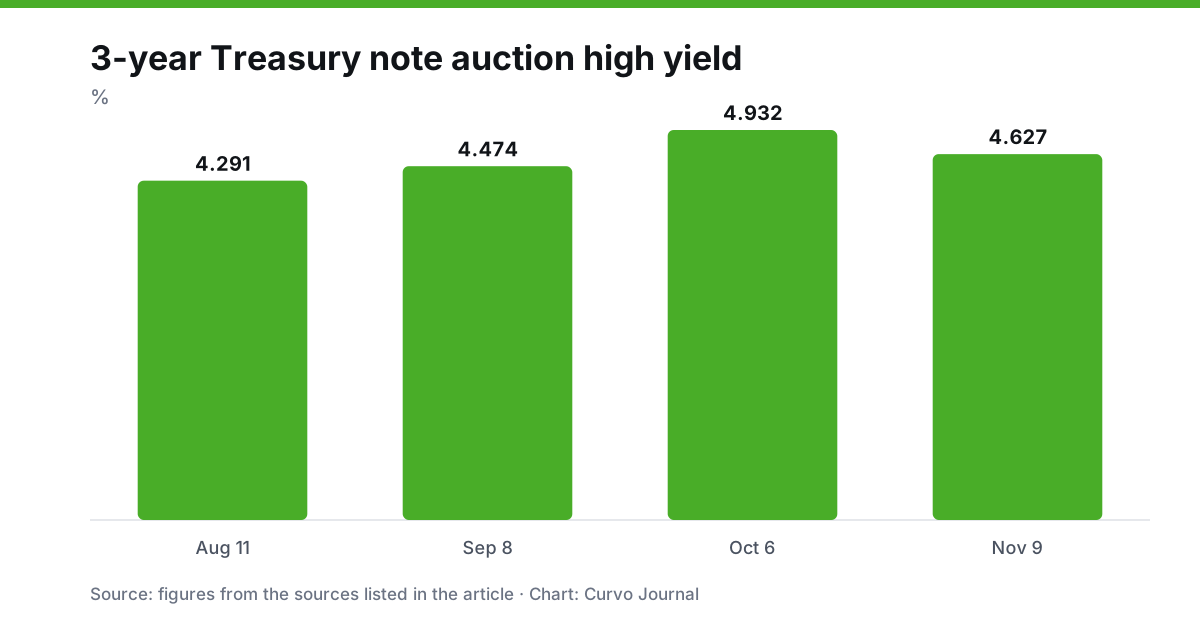
Monday’s three-year note sale cleared at 4.627% with a 2.53 cover, the thinnest cover of the last four monthly three-year auctions.
The refunding in context
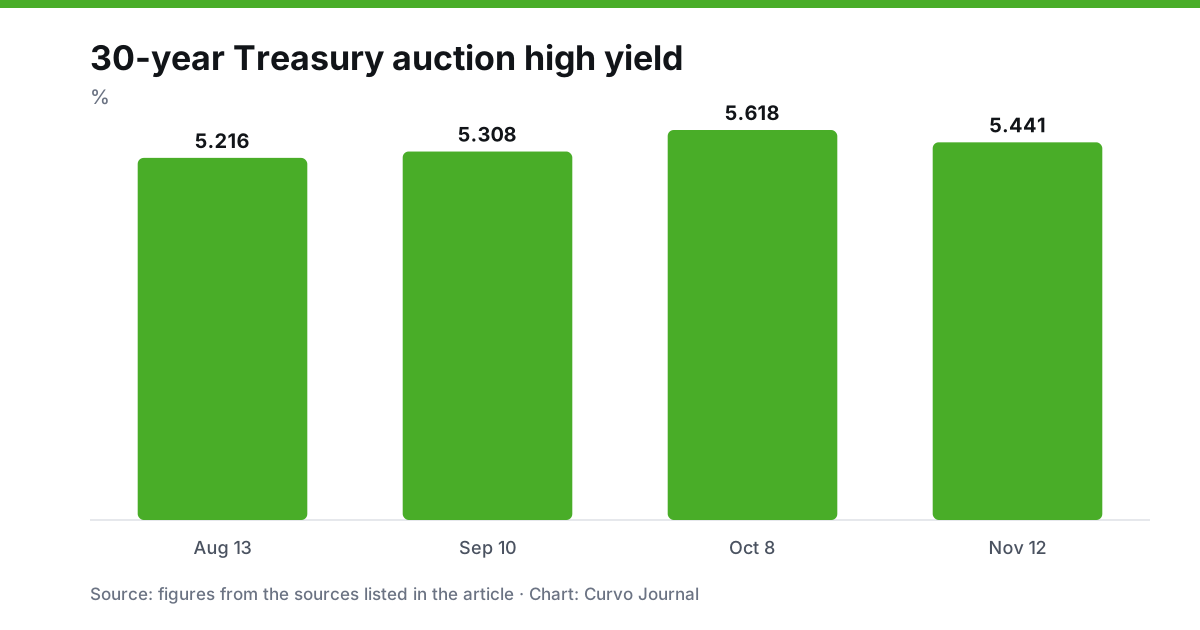
Treasury’s November refunding totals $125 billion: $58 billion of three-year notes, $42 billion of 10-year notes and $25 billion of 30-year bonds. The package refinances about $97 billion of maturing privately held securities and raises roughly $28 billion of new cash. The August refunding was also $125 billion, with about $96.3 billion of rollover and $28.7 billion of new cash, so the total did not change and the cash component dipped by about $700 million.
Why 5% gets attention
The 5% mark is a round number rather than a policy line. Crossing it changes no rule, but the 10-year yield is a benchmark for corporate borrowing and a reference point for mortgage pricing, which also depends on prepayment expectations, credit risk and mortgage-bond spreads. A 5% Treasury yield does not mean a 5% mortgage.
For bondholders, the arithmetic is straightforward. As a hypothetical, a portfolio with a modified duration of eight years would lose roughly 0.88% in price for an 11-basis-point rise in yields, before accounting for convexity.
What to watch
The 30-year bond auction on Thursday closes the refunding and tests demand at the long end after a day when the benchmark traded at the 5% threshold. Beyond supply, the next move depends on whether the inflation data change the Fed’s stance in December.
Prepared with AI assistance from public sources and reviewed under our editorial policy. Not investment advice.