Treasury Auction Guidance Unchanged at August 2026 Refunding
Treasury's Aug. 5, 2026 refunding set $125 billion of 3-, 10- and 30-year auctions, raising about $28.7 billion in new cash and keeping coupon sizes steady.
WASHINGTON — The Treasury Department on August 5, 2026 left its Treasury auction guidance unchanged for a second straight refunding, announcing $125 billion of 3-year, 10-year and 30-year securities and saying it expected to keep nominal coupon and floating-rate note sizes steady for at least the next several quarters. The statement, from Deputy Assistant Secretary for Federal Finance Brian Smith, arrived a week after the Federal Reserve held rates with three dissents in favor of a hike.
The August Treasury auction package
Treasury scheduled $58 billion of 3-year notes maturing August 15, 2029 for Tuesday, August 11; $42 billion of 10-year notes maturing August 15, 2036 for Wednesday, August 12; and $25 billion of 30-year bonds maturing August 15, 2056 for Thursday, August 13. All three auctions were set for 1:00 p.m. Eastern time, with settlement on Monday, August 17.
The sales would refund $96.3 billion of securities maturing on August 15 and raise about $28.7 billion in new cash from private investors. That new-money figure was smaller than the roughly $41.7 billion raised at the May refunding, which carried the same $125 billion in total offerings but faced a smaller pool of maturing debt.
Guidance holds, and bills carry the load
The core message was continuity. Treasury repeated, word for word, the expectation that it would maintain coupon and floating-rate note auction sizes for at least the next several quarters based on current projections of borrowing needs. Bond investors read that sentence as a commitment that the supply of longer-dated debt would not increase in the near future.
That leaves Treasury bills as the shock absorber. The statement said Treasury might issue short-dated cash management bills, planned to reduce the sizes of shorter-dated bill auctions in September, and expected to increase sizes across the bill curve in October. The sequence likely reflects the seasonal pattern of federal cash flows, including corporate and individual tax receipts in mid-September followed by heavier financing needs at the start of the new fiscal year.
On inflation-protected securities, Treasury said it would keep auction sizes at current levels through the August-to-October quarter. On buybacks, it again planned up to $38 billion of purchases of off-the-run securities for liquidity support and up to $25 billion in the 1-month to 2-year bucket for cash management.
Why the 10-year matters most
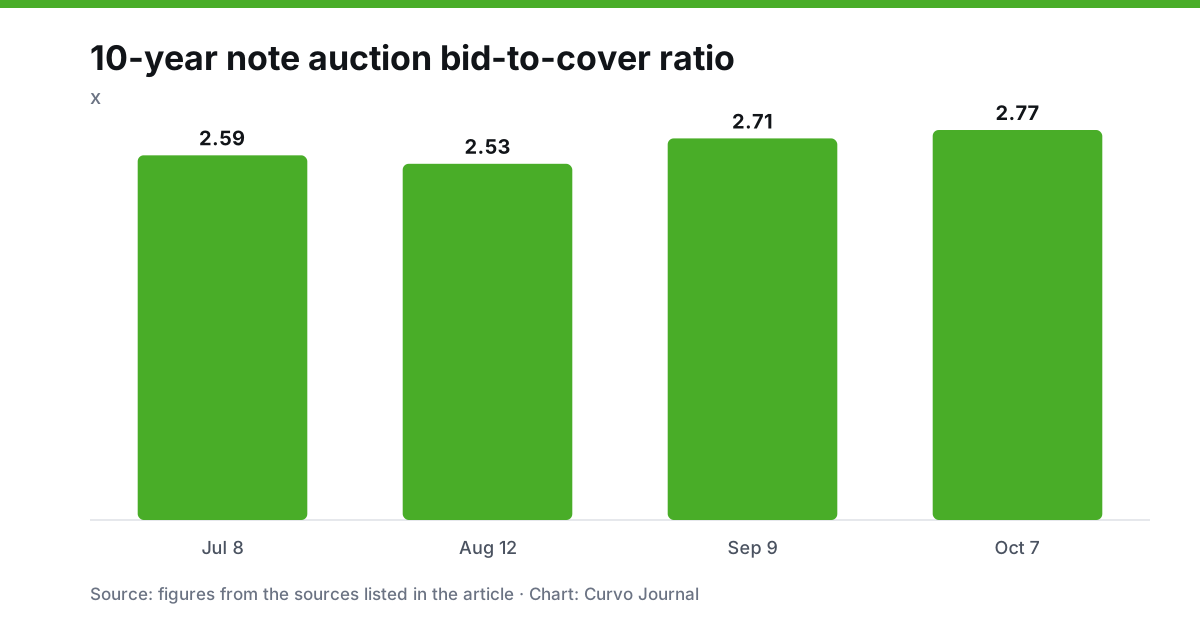
For the bond market, the August 12 sale of a new 10-year note was the centerpiece. The 10-year Treasury is the benchmark for mortgage rates, corporate borrowing and a broad range of asset valuations. The previous 10-year issue, auctioned in May with a 4.375 percent coupon, had been reopened in June and July at progressively higher yields. A new issue in August would show where investors were willing to set a fresh coupon after a summer of elevated inflation readings and hawkish dissent at the Fed.
Steady coupon sizes help on that front by removing the risk of a supply surprise. Any rise in yields at the August auctions would therefore reflect investor demand for compensation, not additional issuance.
The broader backdrop
The decision to hold auction sizes is also a statement about fiscal projections. Treasury tied its guidance to current estimates of borrowing needs, which means a material change in deficits or cash balances could alter the outlook. For now, the department judged that bills could absorb the swings.
That choice shifts relative supply toward the short end of the curve at a time when markets were pricing the possibility of a Fed rate increase. Heavier bill issuance in October, alongside a potentially higher policy rate, would keep front-end yields sensitive to every Fed signal.
What to watch
The three refunding auctions in the week of August 10 will provide the first market verdict, especially the bid-to-cover ratios and dealer takedowns at the 10- and 30-year sales. Beyond that, the November refunding is the next opportunity for Treasury to change its guidance. Any softening of the at-least-several-quarters language would be the clearest sign that larger coupon auctions are coming.
Prepared with AI assistance from public sources and reviewed under our editorial policy. Not investment advice.