How Treasury Auctions Work: Bids, Pricing and Results
How Treasury auctions work: how the government sells bills, notes and bonds, how competitive and noncompetitive bids differ, and how to read auction results.

A Treasury auction is the public sale through which the U.S. government borrows money. The Treasury Department sells bills, notes, bonds, Treasury Inflation-Protected Securities (TIPS) and floating rate notes to investors on a regular calendar, and the prices and yields set at those sales become the starting point for Treasury trading in the secondary market. Most of what the federal government raises through borrowing passes through this process.
The mechanics matter for anyone following Treasury yields. A weak or strong auction can move prices, and the outcomes are reported in the financial press as a gauge of demand for U.S. debt. This guide describes the process at a general level, based on the Treasury’s own descriptions, and points to where the details are published.
In brief
- Treasury sells securities at scheduled public auctions and announces each offering in advance.
- Bidders submit either competitive bids, which name a yield, or noncompetitive bids, which accept whatever yield results.
- Auctions are single-price: every successful bidder receives the same rate, set by the highest accepted competitive bid.
- Results are published when the auction closes, including measures of demand.
- Individual investors can buy at auction through TreasuryDirect, using noncompetitive bids.
What Treasury sells
The Treasury offers several types of marketable securities. Bills are short-term and are sold at a discount to face value, with the return equal to the difference. Notes and bonds are longer-term and pay interest every six months, with a fixed coupon set at the auction. TIPS pay a fixed rate on a principal amount that adjusts with inflation. Floating rate notes pay interest that resets based on a benchmark short-term rate. Each type is auctioned on its own regular pattern, and the TreasuryDirect site posts the schedule.
The Treasury publishes a tentative auction schedule on a quarterly basis. According to TreasuryDirect, the schedule is usually posted on the first Wednesday of February, May, August and November, and dates can change though they rarely do. The Treasury also indicates the general pattern of when each type of security usually auctions. For each specific auction, an announcement states the amount offered, the maturity, the auction date and the settlement date. Announcements are available on the TreasuryDirect website and by email subscription.
Who can bid
Anyone can take part, either directly or through an intermediary. The largest buyers are primary dealers, which are banks and securities firms that trade directly with the Federal Reserve Bank of New York and are expected to participate in Treasury auctions. Other direct bidders include investment funds and large institutions that bid for their own accounts. Indirect bidders place orders through a dealer or broker, a category that includes foreign central banks and many investment managers. Reports on auction results usually break out demand by these three groups.
Individuals can also buy. Through TreasuryDirect, the Treasury’s online platform, investors can enter noncompetitive bids. Brokers and banks provide access to competitive and noncompetitive bids for a wider range of customers.
Competitive and noncompetitive bids
The two bid types are the center of how an auction works.
A noncompetitive bid does not state a yield. The bidder agrees to accept the rate that comes out of the auction and is guaranteed to receive the full amount requested, up to a limit. TreasuryDirect states that noncompetitive bids are capped at $10 million per auction and that most individual investors bid this way. TreasuryDirect itself accepts only noncompetitive bids.
A competitive bid names the yield, or for bills the discount rate, that the bidder is willing to accept. A competitive bidder may receive all, part or none of the amount requested, depending on how the bid compares with the final result. TreasuryDirect states that a single bidder’s competitive awards are capped at 35 percent of the offering amount, less the bidder’s net long position in the security. A bidder cannot place both types of bid in the same auction.
The rules governing auctions are set out in the Uniform Offering Circular, 31 CFR Part 356, which is available on eCFR. It defines eligibility, bid limits, how awards are made and the treatment of special categories of investor.
How the price is set
Treasury auctions use a single-price format. Noncompetitive bids are accepted first. The remaining amount is awarded to competitive bidders in order, starting with the lowest yield, which is the most attractive to the government as a borrower, and moving up until the total offered is filled. The highest yield accepted is the stop-out rate, sometimes called the high yield or high rate. TreasuryDirect describes the outcome this way: every successful bidder, competitive or noncompetitive, pays the same price, which is set by the highest rate, yield or discount margin among the accepted competitive bids.
This format encourages bidders to submit their true valuation. Under a system in which each bidder paid its own bid, a bidder might shade the bid to avoid overpaying. When everyone pays the market-clearing price, bidding aggressively carries less risk of overpaying, which is meant to lower the cost to the government. For notes and bonds, the coupon rate is also fixed at the auction, and the offering rules on eCFR explain how it is derived from the result.
Reading auction results
Results are released shortly after the bidding window closes. The Treasury posts them on TreasuryDirect, and news services report them quickly. Several measures are widely followed.
High yield or high rate. The stop-out yield at which the auction cleared. Comparing it with the yield the market was quoting just before the auction shows whether the sale went at a better or worse price than expected. A result above the pre-auction level is often called a tail, and one below it a stop-through.
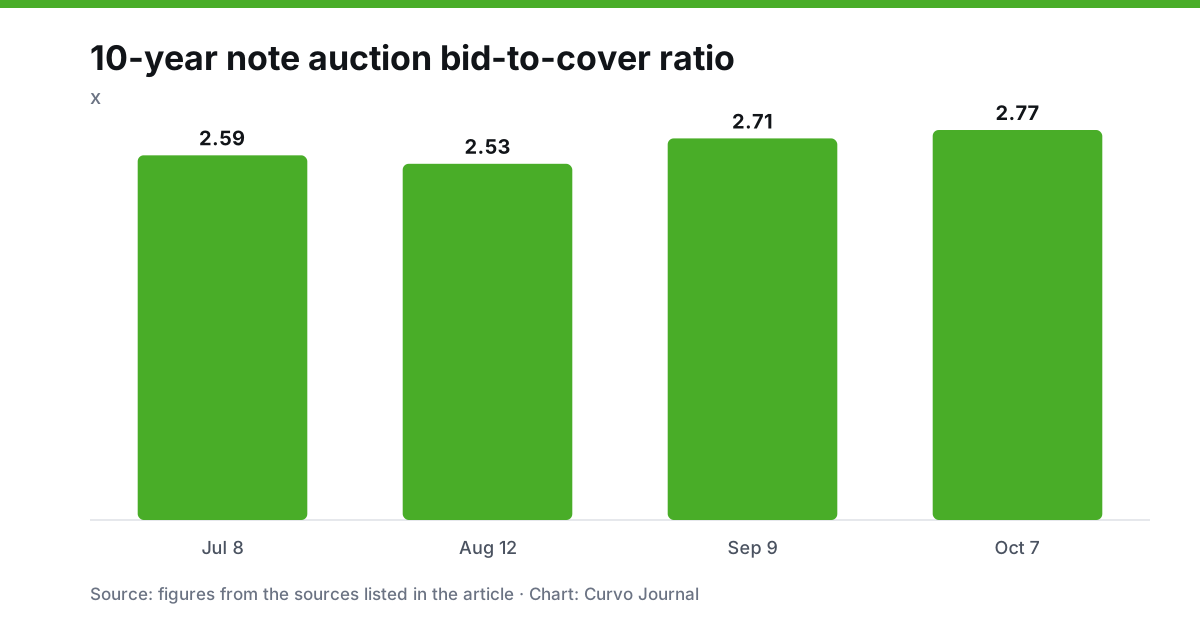
Bid-to-cover ratio. The total amount of bids received divided by the amount offered. A higher ratio indicates stronger demand relative to supply. The ratio is best compared with that security’s recent auctions rather than viewed in isolation.
Bidder breakdown. The share awarded to primary dealers, direct bidders and indirect bidders. A larger share going to dealers can suggest less end-investor demand, since dealers are required to bid and often resell the securities.
Reopenings. Many auctions add to an existing issue, so the new securities are fungible with ones already outstanding. The announcement says whether an auction is a new issue or a reopening.
From auction to the secondary market
Once a security is auctioned and settles, it trades in the secondary market, which is a decentralized market among dealers and investors. Prices in that market determine the yield quoted every day, including the yields that Treasury uses as inputs to the official par yield curve. Newly auctioned securities in each maturity are called on-the-run, and they usually trade most actively and with the tightest spreads. Older securities are off-the-run.
There is also a feedback loop. Because the on-the-run issues are the inputs to the official curve, auction outcomes help set the reference points of the yield curve itself. A large increase in the amount to be auctioned can add pressure on yields if investors need an incentive to absorb the additional supply. Conversely, strong demand can bring yields down.
A worked example
Imagine a hypothetical auction of $40 billion in notes. Noncompetitive bids total $1 billion and are accepted in full. Competitive bidders submit offers for $119 billion more, a total of $120 billion in bids. The bid-to-cover ratio is $120 billion divided by $40 billion, or 3.0.
The Treasury fills the remaining $39 billion by working up from the lowest competitive yield. Suppose it reaches the full $39 billion at a yield of 4.20 percent. That is the high yield, and every winning bidder gets that yield, including the bidder who offered 4.15 percent and the noncompetitive bidders. A competitive bidder who asked for 4.25 percent receives nothing. The 4.20 percent result becomes the reference point that market participants compare with the pre-auction yield. All numbers here are invented to show the process.
Why it matters
Treasury yields underpin the pricing of mortgages, corporate bonds and many other instruments. The auction process is where new supply meets investor demand. Regular, predictable and transparent auctions help keep the market functioning, and the Treasury’s long-standing practice of announcing the schedule in advance lets investors plan. Anyone tracking the bond market can follow the results through TreasuryDirect, and compare them with moves in the 10-year Treasury yield and the shape of the yield curve.
FAQ
What is a Treasury auction?
It is a public sale in which the U.S. government sells Treasury securities to investors to finance federal spending and refinance maturing debt.
How do I buy at a Treasury auction?
You can bid through TreasuryDirect with a noncompetitive bid, or through a bank or broker that offers access to Treasury auctions.
What is the difference between a competitive and a noncompetitive bid?
A competitive bid names a yield and may be filled in part or not at all. A noncompetitive bid accepts the auction’s yield and is filled in full, up to the limit.
What does single-price mean?
All winning bidders pay the same price, set by the highest accepted competitive bid.
What is a bid-to-cover ratio?
It is the total bids received divided by the amount offered. Higher ratios generally mean stronger demand.
When are auctions held?
On a regular schedule that varies by security type. The Treasury publishes the tentative calendar quarterly and announces each auction beforehand.
Prepared with AI assistance from public sources and reviewed under our editorial policy. Not investment advice.